


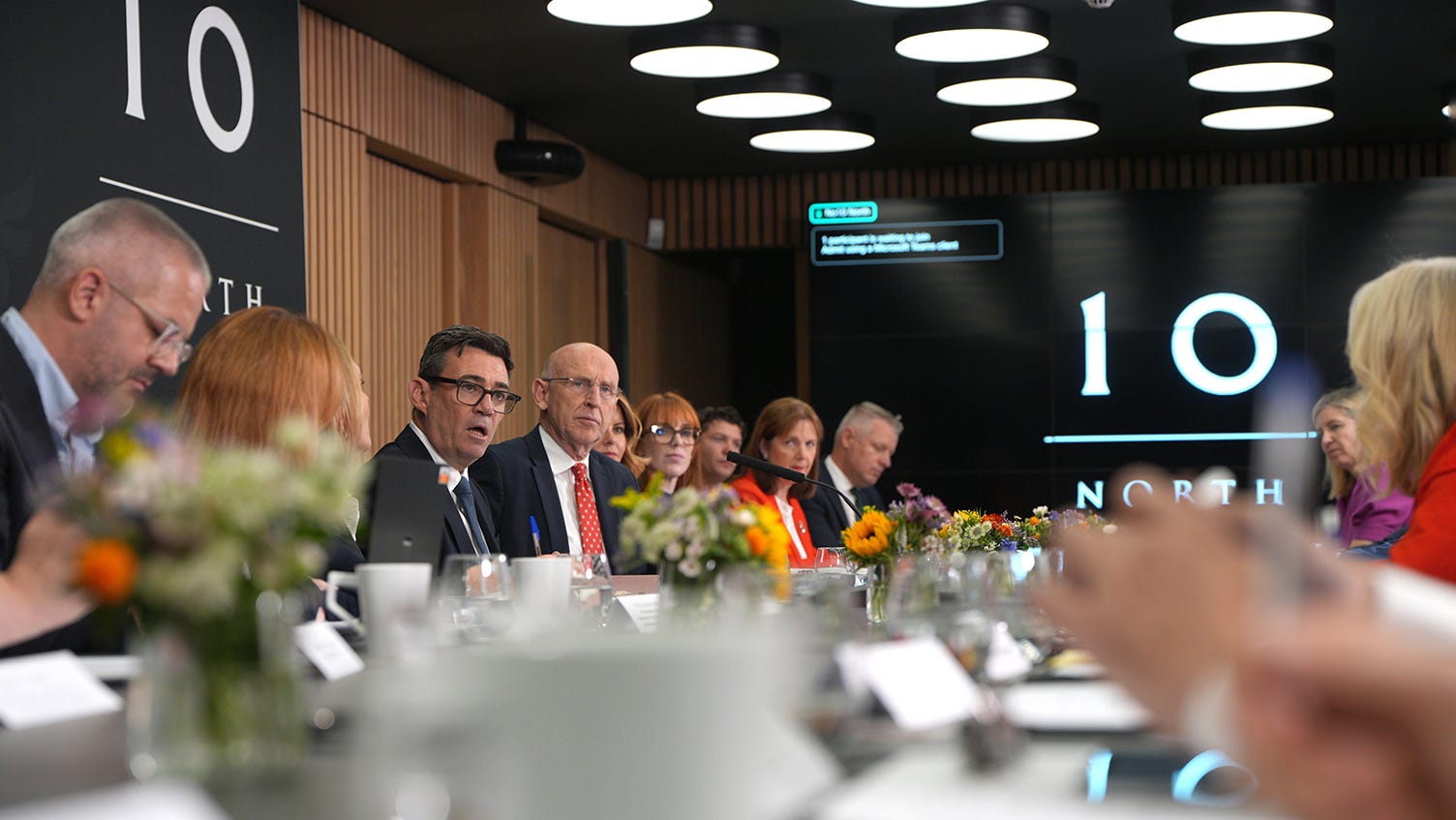
The IfG and others has written plenty, and no doubt will write plenty more, on the merits of Andy Burnham’s early decision to split his No.10 operation between Downing Street and Manchester. Most of that commentary has focus on the ways it will affect how central government works. I want to focus on a different effect it is likely to have: helping the broader policy ecosystem in Manchester to flourish.
I declare a personal interest. For the last four years, I’ve been living in Manchester, travelling one day a week down to IfG HQ in London and spending the rest of my time in the nation’s second city (with apologies to my colleagues, and any other readers, hailing from the West Midlands). The time I’ve spent here has made clear that Manchester already has an engaged group with a keen interest in government policy, especially on devolution, but there is potential for it to grow in the coming years.
The main event
That strong existing policy ecosystem was on full show at our recent event in Manchester. Two of our panellists – Luke Raikes, now at the Fabians, and Jen Williams, now at the FT – have been writing about policy and politics from Manchester long before I arrived in the city. The audience was also filled with an encouraging mix of civil servants, local policy makers, other think tankers and a broader set of interested people from a range of public, private and third sector organisations. And the IfG is not alone. I’ve attended events since the start of September organised by other think tanks, some of whom have had a presence here for decades.
No.10 North is itself a product of this depth of policy talent. Part of Burnham’s motivation for setting up the office was his desire to keep working with people who helped him during his time as mayor in the city. Several former Greater Manchester Combined Authority employees have moved across in either official or political roles. For many of these people, the prospect of re-locating to London would have been unattractive and/or impractical given their personal circumstances. The new office means they can work at the heart of government without uprooting their lives and families.
For many, the prospect of re-locating to London is unattractive and/or impractical. The new office means they can work at the heart of government without uprooting their lives and families.
Still, I am struck by the scope Manchester still has to grow as a hub for policy. The experience of being a wonk up here is very different to being in Westminster. SW1 has scale (people who work there call it SW1 by the way, even if no one else does).
Down in the capital there are more new people to build relationships with, to collaborate with and invite to events. Up here, the policy world is still small enough that everyone knows everyone. Or, if they don’t, they are probably at most one connection removed. Events are a rare treat rather than a constant stream. And meeting up with most organisations means waiting for a London day or meeting through a screen.
Will we see a ‘No.10 North pull’?
So how might No.10 North change this? First, sitting at the heart of the Burnham government’s devolution agenda, it should lead to a bigger spread of jobs and organisations across the rest of the country outside Westminster. Policy jobs within the public sector will move: people will be more confident to take a civil service job outside London understanding that it won’t disadvantage their careers. And the plan to slim down Whitehall while devolving more to mayors will create more jobs at that layer of government. Where government moves, the wider ecosystem will follow too.
Think tanks will continue to do more outside London – as the IfG has been already doing in recent years, for example through our Devolab event series. And more organisations will set up northern outposts to access talent and demonstrate their interest in the government’s agenda.
Manchester benefits not just from Burnham’s time as mayor but of the more than 20 years of local leadership from Richard Leese, Howard Bernstein and others
But it will also confer a specific Manchester benefit. Manchester already had a more developed policy ecosystem than most other cities outside London – another benefit not just of Burnham’s time as mayor but of the more than 20 years of local leadership from Richard Leese, Howard Bernstein and others. But where it might previously have been very hard to decide where organisations should set up a non-London base, the PM’s presence makes Manchester the clear winner.
Second city status
London will remain the main player in town, policy wise: no matter how enthusiastically this government pursues devolution the bulk of politicians and their officials will remain in that SW1 postcode. But a second hub – dare I say again, second city – will be a good thing for the health of policy debate and discussion.
These things benefit from scale, and Manchester now has the prospect of reaching a critical mass. My hope is it will convince more organisations to take the plunge. This in turn will open up more opportunities to good people who – for many varied and understandable reasons – don’t want to work in London. Building relationships and convening conversations across the third, public and private sectors will become easier. The default of holding events in London will lessen as a credible regular alternative emerges.
The bulk of politicians and their officials will remain in SW1. But a second hub – dare I say again, second city – will be a good thing for the health of policy debate and discussion.
Of course none of this is guaranteed to happen. Many organisations will no doubt be waiting to see how No.10 North and the broader devolution agenda progresses. The Westminster bubble may blow through unscathed. But watching on from Manchester, I’m optimistic.
Tom Pope is the IfG’s chief economist.
I have one major concern.
1 Elections, Democracy in Devolution
At national elections we can expect a turnout of around 65 to 70%.
Local elections are more like 40%. What is the figure for Mayrol elections and what will it be for the rest of the country in the variety of structures we will have at the end of the current round of regional reform, which could take another 3 or 4 years?
How many tiers of government will there be?
How frequent will the different elections be?
What will be the cost ? Will those who win be paid and if so how much and will they all get pensions from the state / local electorate?
When the new structures are in place, will the total of civil servants employed be higher than it is now?
I do wonder though what this all means for brum. I'm worried we will end up forgotten about between the London and the North, as has happened in the past.